Indian benchmark indices Sensex and Nifty are likely to open largely flat-to-negative on Monday, with GIFT Nifty pointing to a muted start even as gains across Asian markets and a sharp decline in crude oil prices provide a supportive global backdrop. Brent crude has fallen towards $101 a barrel and US equity futures are higher, although persistent geopolitical uncertainty in the Middle East could keep investors cautious.
GIFT Nifty was trading at 23,340 around 7:55 am, down 21 points, or 0.1 percent. Indian benchmark indices ended mixed in the previous session. The Sensex slipped 20 points to 74,294.96, while the Nifty gained 75.80 points to 23,346.40 as weakness in IT and Tata Group stocks offset some of the support from falling crude prices...... . VALI disclosures . .....
"Value Appraisal and Leveraged Investing"
Pages
- Home
- HOLDINGS:
- *****
- BANK BEES
- GOLDBEES
- SILVER BEES
- NOTES
- TECHNICAL GUIDE (click here)
- Abbreviations for Commerce
- IT
- Disclaimer: Derivatives trading must be done only by traders who fully understand the risks associated with them and strictly apply risk mechanisms like stop-losses. The information is only for consumption by the client and such material should not be redistributed. We do not recommend any particular stock, securities and strategies for trading. The securities quoted are exemplary and are not recommendatory. The stock names mentioned in this article are purely for showing how to do analysis. Take your own decision before investing.
- Foreign Direct Investment (FDI) and Foreign Portfolio Investment (FPI) are distinct forms of international investment with different characteristics and implications. FDI involves a long-term commitment with the aim of controlling or influencing the operations of a foreign business, while FPI involves investing in foreign financial assets like stocks and bonds, typically with a shorter-term focus and without gaining operational control. Here's a more detailed breakdown: Foreign Direct Investment (FDI): Long-term commitment: FDI investors typically seek a lasting presence in the foreign market, often through establishing new businesses (greenfield investment) or acquiring existing ones (brownfield investment). Control and influence: A key feature of FDI is the investor's ability to influence or control the operations of the foreign business. Resource and technology transfer: FDI often involves the transfer of resources, technology, and expertise from the investor's country to the host country, potentially boosting economic development. Potential for higher returns: While FDI involves greater risk, it also offers the potential for higher long-term returns. Foreign Portfolio Investment (FPI): Short-term focus: FPI investors typically have a shorter-term investment horizon, seeking to profit from market fluctuations and changes in asset prices. Passive investment: FPI investments are typically passive, meaning investors do not have direct control or influence over the management of the companies they invest in. Focus on financial assets: FPI involves investing in financial assets like stocks, bonds, and other securities. Liquidity and volatility: FPI can be more liquid than FDI, but it is also more susceptible to market volatility and can be easily withdrawn. In essence: FDI is like buying a business or building a factory in another country, aiming for long-term control and influence. FPI is like buying shares of a company on a stock exchange, with the goal of making a profit from price changes in the short-term.
logo
Monday, September 21, 2026
21/09/26, Shaleen Agrawal's Report on Market
Sunday, September 20, 2026
20/09/26, STOCKS TO WATCH THIS WEEK
The Sensex fell 0.65% this week, while the Nifty 50 declined 0.2%. Crude oil prices continued above $100 per barrel and the 10-year yield remained elevated. These continued to weigh on sentiment.
Is there still room for stocks to move higher despite the broader weakness?
Several brokerages have recently updated their views on individual companies. Bernstein, Jefferies, Nuvama Research, CLSA, HSBC, Motilal Oswal and Emkay have issued ‘Buy’ or equivalent positive ratings on stocks across banking, power, defence, infrastructure and consumer internet.
Here are 10 stocks where brokerage price targets indicate 25% to 62% upside.
Bernstein on HDFC Bank: 62% upside
Bernstein assigned ‘Outperform’ rating to HDFC Bank with a target price of Rs 1,150. This indicates around 62% upside from the current market price.
According to the brokerage report, HDFC Bank has submitted its chief executive officer (CEO) candidates to the Reserve Bank of India (RBI) ahead of Jagdishan’s retirement.
It has also sought a full three-year term for the incoming CEO. Bernstein believes the timing could reduce concerns around the succession process.
Nuvama on Inox Wind: 58.9% upside
Nuvama rated Inox Wind a ‘Buy’ with a target price of Rs 123, implying 58.9% upside.
The renewable energy pipeline remains a key part of the brokerage’s assessment. “Renewable tendering remains strong, with 142GW of capacity yet to be converted into PPAs,” for Inox Winds, Nuvama said.
Power purchase agreements (PPAs) are contracts under which electricity is sold to a buyer for an agreed period.
Jefferies on Adani Energy Solutions: 53% upside
Jefferies has ‘Buy’ on Adani Energy Solutions with a target price of Rs 2,060, implying 53% upside.
According to the brokerage report, transmission, smart meters and energy trading are the key areas to watch. Adani Energy’s transmission bid pipeline has also increased to Rs 1.1 lakh crore from Rs 90,000 crore a year earlier.
Bernstein on Swiggy: 52% upside
Bernstein retained ‘Outperform’ on Swiggy with a target price of Rs 430, indicating around 52% upside.
The brokerage expects Swiggy and its food-delivery peer Eternal to remain important players in the segment.
Its assessment also factors in their existing consumer base and scale as competition increases.
Jefferies on Hitachi Energy India: 50% upside
Jefferies retained ‘Buy’ on Hitachi Energy India and set a target price of Rs 45,790, implying 50% upside.
According to the brokerage report, Hitachi Energy has an order book of around Rs 32,200 crore. It also secured two large domestic high-voltage direct current (HVDC) orders worth more than Rs 19,000 crore during FY25-26.
CLSA assigned an ‘Outperform’ rating to BEL with a target price of Rs 522, implying 35.3% upside.
Speaking on Bharat Electronics’ revenue prospects, “Rising electronics in defence equipment and its nomination for two multi-billion dollar projects are key catalysts,” CLSA said.
The brokerage also highlighted defence procurement following the India-Pakistan skirmishes.
Jefferies on Torrent Power: 37% upside
Jefferies has retainedi‘Buy’ on Torrent Power with a target price of Rs 1,780, implying 37% upside.
Torrent Power currently has around 2 gigawatts (GW) of renewable energy capacity and aims to reach 10 GW by 2030.
“Renewable energy capacity to rise at least 3x by FY30,” the brokerage report said.
HSBC on Hindustan Aeronautics: 29.5% upside
HSBC has initiated coverage on HAL with a ‘Buy’ rating and a target price of Rs 6,350, indicating 29.5% upside.
“Large order book gives multi-year revenue and earnings visibility for HAL. We expect LCA Mk1 deliveries to pick up. Over the coming years, new platform deliveries should drive ROH revenues higher,” HSBC said.
Motilal Oswal on Indraprastha Gas: 27% upside
Motilal Oswal retained its ‘Buy’ rating on Indraprastha Gas with a target price of Rs 195, implying around 27% upside.
According to the brokerage report, recent price increases for compressed natural gas (CNG) and piped natural gas (PNG) could support margins for IGL. .
However, electric vehicle adoption in Delhi remains a key factor to monitor.
Emkay on GMR Airports: 25% upside
Emkay has initiated coverage on GMR Airports with a ‘Buy’ rating and a target price of Rs 120, implying around 25% upside.
The brokerage is focusing on the company’s non-aeronautical businesses, including duty-free, cargo, parking and retail. “The GAL platform provides GMR with a dedicated vehicle to scale and monetize non-aero opportunities across its airport network,” Emkay said.
What investors need to watch
Taken together, these 10 brokerage calls cover a wide range of sectors. The projected upside ranges from 25% to 62%, based on the respective brokerage targets.
Written by Olivia Kunjumon
Source: FinancialExpress
20/09/26, Jyoti CNC Automation
Jyoti CNC Automation manufactures CNC metal-cutting machines. Jyoti CNC has installed over 140,000 CNC machines in 60+ countries worldwide. The company offers over 200 variants across 44 product verticals, ranging from entry-level turning and milling centers to high-end multi-axis and 5-axis machines.
Jyoti CNC serves diverse sectors. In Q1FY27, the aerospace and defense sector accounted for 37% of revenue, followed by auto and auto components (35%), general engineering (17%), electronic manufacturing services (6%), dies and molds (4%), and others (1%).
Order Book at ₹4,848 Cr: Aerospace Takes the Lead
As of 30 June, 2026, Jyoti CNC holds a total order book of ₹4,848 crore. Aerospace & defence (38%), general engineering (20%), auto & auto components (19%), and EMS (13%) lead the order book. Management expects full-year order intake to reach ₹2,500 crore to ₹3,000 crore. Of this, the company won ₹601 crore worth of orders in Q1FY27.
Jyoti CNC currently operates a base annual installed capacity of 6,000 CNC machines. In Q1 FY27, the plant operated at 86% capacity utilization. The company produced 5,550 machines in FY26 and expects to exceed 8,000+ machines in FY27. It is expanding capacity by 10,000 CNC machines, bringing total domestic annual capacity to 16,000 machines.
16,000-Machine Capacity Leap Powers Global Deals
The company targets full commissioning of this plant by the end of October 2026. Supported by the new capacity, total volume is projected to cross 8,000+ machines in FY27. The added capacity is the key reason behind FY27 guidance of 25-30% revenue growth. For aerospace components, Jyoti makes multi-axis machines, including
GU 8: A 5-axis gantry-type machining center specifically developed for complex structural aerospace parts and tooling.
Tachyon Beta: A compact, simultaneous 5-axis machine driven by linear motors for high-speed precision manufacturing.
ATM 200: An inverted turning center catered to precision aerospace engineering.
Demand is driven by facility upgrades by Indian component suppliers. They are upgrading their facilities with Jyoti to manufacture parts for defense and commercial aerospace programs, including Airbus, Dassault, and Hindustan Aeronautics. Jyoti delivers advanced 5-axis centers to defense and aerospace clients across Europe, China, and Turkey.
Another demand driver is the mandate for promoting domestic defence manufacturing. This, coupled with import substitution, is accelerating demand for local CNC machine tools. Shifting manufacturing bases to India by global defence and aerospace players is also a tailwind for Jyoti CNC Business.
👉Huron Accounting Shift Masks 24% Topline Surge
Financially, the company’s revenue grew 24% year-on-year to ₹508.5 crore in Q1FY27, driven by 25.9% volume growth to 1,406 units and average realisation of ₹34.6 lakh. EBITDA (Earnings Before Interest, Tax, Depreciation, and Amortisation) surged 8.6% to ₹108.8 crore, with margins at 21.4%. Net profit fell 20% to ₹57.1 crore.
Profitability and margin fell due to a change in revenue recognition accounting methodology at the French subsidiary “Huron”. It moved away from the percentage-of-completion method and began booking revenue upon machine dispatch and receipt of end-user export certification. As a result, Huron deferred ₹35 crore in unbilled revenue and ₹20-22 crore in EBITDA.
France is investigating Huron for alleged export violations. This is a key risk to keep track of.
Written by Madhavendra
Source: Financial Express
Friday, September 18, 2026
18/09/26, Speaking on the sidelines of Moneycontrol's Mutual Fund Summit - Delhi edition 2026
Indian economy can withstand crude oil prices of $120 a barrel, but the stock market may still react negatively, said Anish Tawakley, CIO, DSP Mutual Fund, drawing a distinction between the economy's ability to absorb higher oil prices and the impact on equities.
Speaking on the sidelines of Moneycontrol's Mutual Fund Summit - Delhi edition 2026, during the session ‘Inevitable India, Uncertain World', Tawakley, Deepak Shenoy, CEO, Capitalmind Mutual Fund, and Sachee Trivedi, Founder & CIO, Trident Capital Investments, discussed the impact of higher crude prices on India, the ability of the economy to absorb the shock and what it could mean for equity marketsTawakley said India's ability to deal with higher crude prices is very different from what it was in the 1990s because the country now has significant foreign exchange reserves. “India needs five million barrels of oil a day and can use the forex reserves to keep buying,” he said.
Economy can handle oil, but markets may still take a hitShenoy of Capitalmind Mutual Fund agreed that India's economy has the ability to absorb higher crude prices, but said investors should not assume that equities will remain insulated. “The economy can handle oil, but the markets may still have a negative impact,” he said.Shenoy said the short-term direction of crude is particularly difficult to predict because geopolitical developments can cause sharp moves. “Oil short term cannot be predicted. It could go to $140, it could go to $160,” he said. At the same time, he said there are forces that could eventually bring additional supply into the market. "Oil has structural downside in pricing but cyclical upside due to geopolitics."He pointed to the possibility of sanctioned oil returning to the market because of political incentives and the supply response that can emerge when crude prices remain high. “If oil prices go higher, US shale gets more profitable at higher prices,” he said.His longer-term view on crude was more benign despite the possibility of a sharp near-term spike. “I think oil can return to $80 in six months,” he said.Magnitude of oil price increase is importantTrivedi said the impact of higher crude cannot be judged simply by looking at the absolute price. The starting point and the magnitude of the increase are equally important. “If oil goes from $65 to $100, that's a 50 percent increase and that's very hard to absorb,” she said. But she said the situation is different when crude is already at elevated levels. “If oil goes from $108 to $120, that's 10-12 percent. That's something which is anticipated and something that people are mentally prepared for,” Trivedi said.She also brought Europe into the discussion, saying the region could face significant pressure from elevated energy costs. “Europe is also feeling the pain and they may compensate households. Winter may be difficult,” she said.Trivedi said the impact of oil should also be viewed through the direction of earnings revisions. “The second derivative is improving,” she said, referring to the trend in earnings. “The upgrades and downgrades ratio has changed,” she added. This could mean that some of the negative news has already been reflected in market expectations. That's the reason she believes that a sharp downside risk is capped and the upside has turned flat for markets.
Thursday, September 17, 2026
17/09/26, Sunil Sankar's Report on Trading Strategy
The Nifty 50 is most likely to see consolidation with a negative bias, especially after the US Federal Reserve expectedly raised interest rates by 25 bps and signalled one more hike this year. The index may attempt to defend the previous day's low of 23,100 amid bearish technical indicators, oil prices holding around the $100-a-barrel mark and US bond yields hovering around the 5 percent level. If the index decisively breaks the 23,100–23,070 zone, a fall below 23,000 cannot be ruled out. However, if it holds above this zone, the 23,400–23,500 levels could be the next targets. Meanwhile, the Bank Nifty needs to defend the 55,800–55,700 zone for a possible upmove towards the 56,700–57,000 zone. A break below this support, however, could trigger panic selling, experts said.
On September 16, the Nifty 50 bounced back 99 points, or 0.43 percent, to 23,218, while the Bank Nifty rallied 498 points, or 0.89 percent, to 56,292. However, market breadth remained in favour of the bears, with about 1,756 shares declining against 1,476 advancing shares on the National Stock Exchange.Disclaimer: The views and investment tips expressed by experts here are their own and not those of us. We advise readers and traders to check with certified experts before taking any investment decisions.
17/09/26, US Federal Reserve
The US Federal Reserve raised interest rates by 25 basis points on Wednesday, delivering its first hike since July 2023 as stubborn inflation, higher energy prices and a resilient economy prompted policymakers to resume monetary tightening after more than three years.
The Federal Open Market Committee unanimously raised the federal funds rate target range to 3.75-4 percent, reversing part of the easing delivered since the Fed ended its previous rate-hike cycle. More importantly, policymakers signalled that Wednesday's move may not be a one-off, with most officials expecting rates to rise further this year.Inflation remains the US Fed's biggest concern
First Fed rate hike of Kevin Warsh era
Wednesday's decision assumes added significance because it is the first interest-rate change since Kevin Warsh became Fed chair in late May.President Donald Trump selected Warsh to lead the Federal Reserve after repeatedly calling for lower interest rates and had said during the selection process that he expected his appointee to favour lower borrowing costs.The Fed's latest decision instead moves monetary policy in the opposite direction, with the central bank raising rates and its projections leaving the door open to further tightening.Warsh had already hardened his rhetoric on inflation before the September meeting. At the Jackson Hole symposium last month, he said policymakers needed confidence that underlying inflation was moving towards the Fed's objective "clearly and at sufficient speed".Wednesday's unanimous decision also comes after three policymakers had favoured raising rates at the Fed's July meeting.The latest move effectively reverses part of the easing delivered by the central bank after its previous tightening cycle. The Fed had last raised rates in July 2023 and subsequently cut borrowing costs six times by a cumulative 175 basis points.Wednesday, September 16, 2026
16/09/26, Trade Setup
Bears are showing no signs of relinquishing control, dragging the Nifty 50 down 1.2 percent despite a gap-up opening on September 15. Technical indicators remain firmly in favour of the bears, while market sentiment has been dampened by elevated US bond yields and crude oil prices, along with caution ahead of the FOMC meeting outcome. The Nifty 50 is expected to consolidate with a negative bias. A break below the crucial support level of 23,000 could strengthen bearish momentum and trigger panic selling. On the upside, the 23,400–23,500 zone is likely to act as a key hurdle, according to experts, who continue to recommend a sell-on-rallies strategy.
Levels for the Nifty50: (cmp23118.60):
Resistance based on pivot points: 23,458, 23,570, and 23,751
Support based on pivot points: 23,096, 22,984, and 22,802
The Nifty 50 formed a long bearish candle on the daily charts, continuing its lower high–lower low structure and reflecting the bears' control. All key moving averages continued to trend downward, while the index fell below the 61.8 percent Fibonacci retracement level of the rally from 22,183 to 24,774. The RSI slipped further to 22.23, its lowest level since March 2025, while the MACD extended its decline, with the red histogram bar expanding for the sixth consecutive session. All these indicators point to continued bearish momentum.
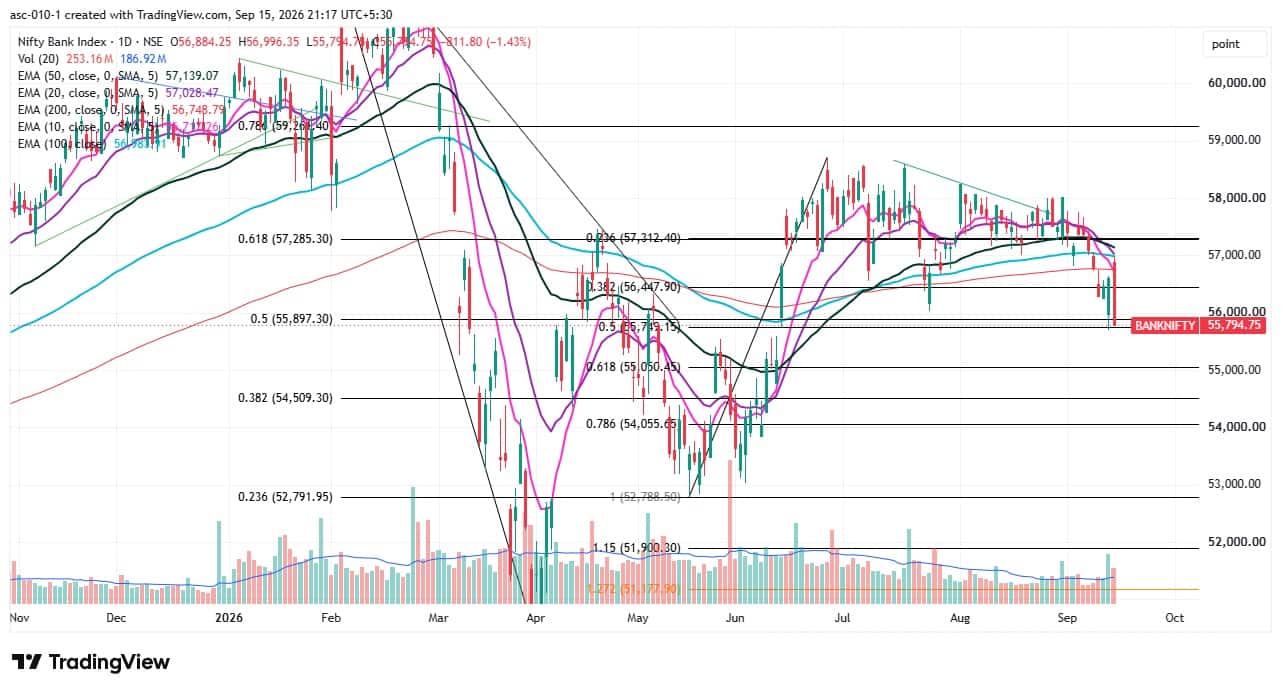
Levels For The BankNifty (55,795)
Resistance based on pivot points: 56,654, 56,938, and 57,397
Support based on pivot points: 55,736, 55,453, and 54,994
Resistance based on Fibonacci retracement: 57,285, 59,261
Support based on Fibonacci retracement: 55,749, 55,050
The Bank Nifty fell 1.43 percent and formed a sizeable red candle on the daily timeframe, signalling the strong presence of bears. The index traded below all key moving averages, with short- and medium-term moving averages trending downward. However, it managed to defend the 50 percent Fibonacci retracement level of the rally from the May low to the June high. The RSI slipped below the 40 level to 33.23, while the MACD maintained its downtrend below the zero line, with the red histogram bar deepening. All these indicators point to bearish phase.
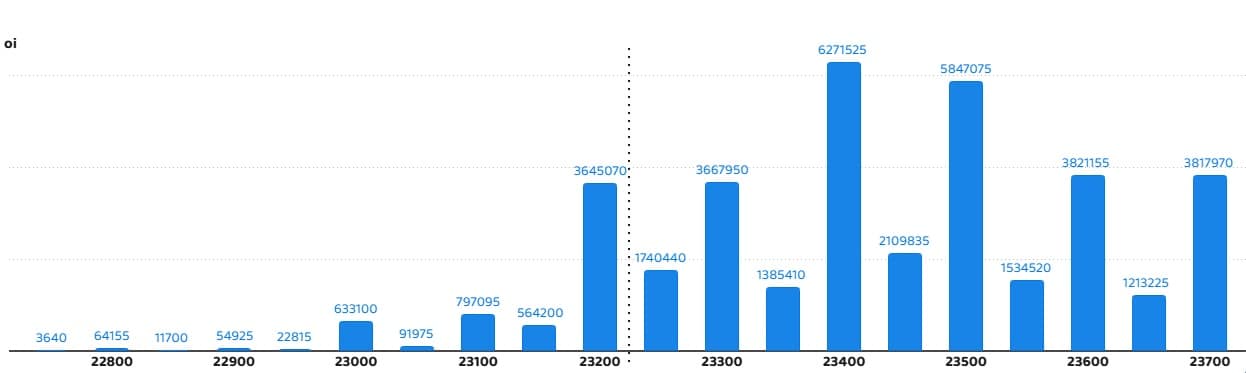
Nifty Call Options Data:
According to the weekly options data, the maximum Call open interest was seen at the 23,400 strike (with 62.71 lakh contracts). This level can act as a key resistance level for the Nifty in the short term. It was followed by the 23,500 strike (58.47 lakh contracts) and 23,600 strike (38.21 lakh contracts).
Maximum Call writing was observed at the 23,400 strike, which saw an addition of 42.02 lakh contracts, followed by the 23,200 and 23,500 strikes, which added 32.32 lakh and 30.7 lakh contracts, respectively. There was hardly any Call unwinding seen in the 22,750-23,700 strike band.
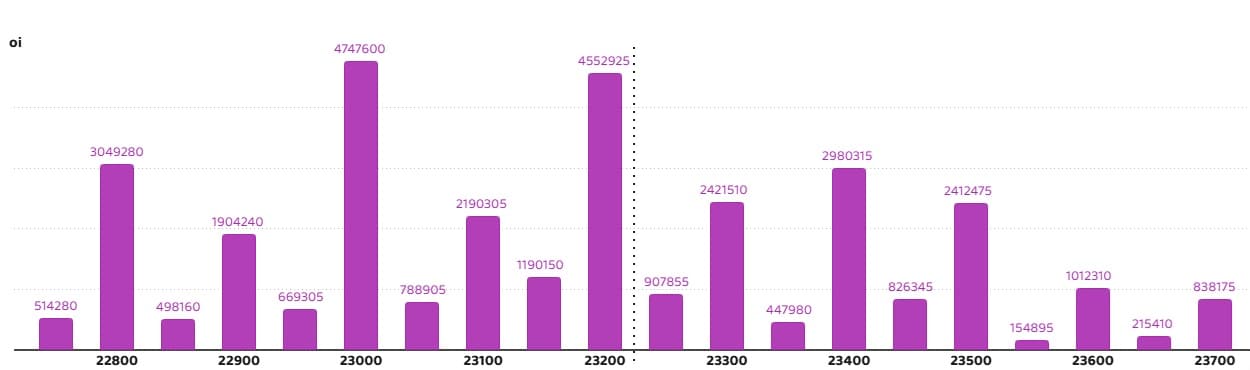
Nifty Put Options Data:
On the Put side, the 23,000 strike holds the maximum Put open interest (with 47.47 lakh contracts), which can act as a key support level for the Nifty in the short term. It was followed by the 23,200 strike (45.52 lakh contracts) and the 22,800 strike (30.49 lakh contracts).
The maximum Put writing was placed at the 23,200 strike, which saw an addition of 28.72 lakh contracts, followed by the 23,000 and 22,800 strikes, which added 19.15 lakh and 15.3 lakh contracts, respectively. There was hardly any Put unwinding seen in the 22,750-23,700 strike band.
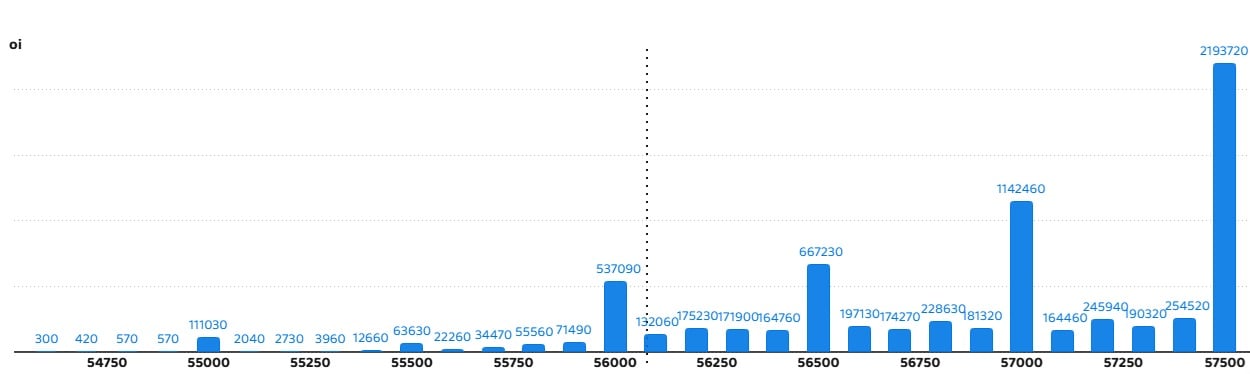
Bank Nifty Call options data:
According to the monthly options data, the maximum Call open interest was seen at the 57,500 strike, with 21.93 lakh contracts. This can act as a key resistance level for the index in the short term. It was followed by the 57,000 strike (11.42 lakh contracts) and the 56,500 strike (6.67 lakh contracts).
Maximum Call writing was observed at the 57,000 strike (with the addition of 3.02 lakh contracts), followed by the 56,000 strike (2.74 lakh contracts) and 56,500 strike (2.68 lakh contracts). The maximum Call unwinding was seen at the 57,300 strike, which shed 13,380 contracts, followed by the 55,000 strike, which shed 1,080 contracts.
Bank Nifty put options data:
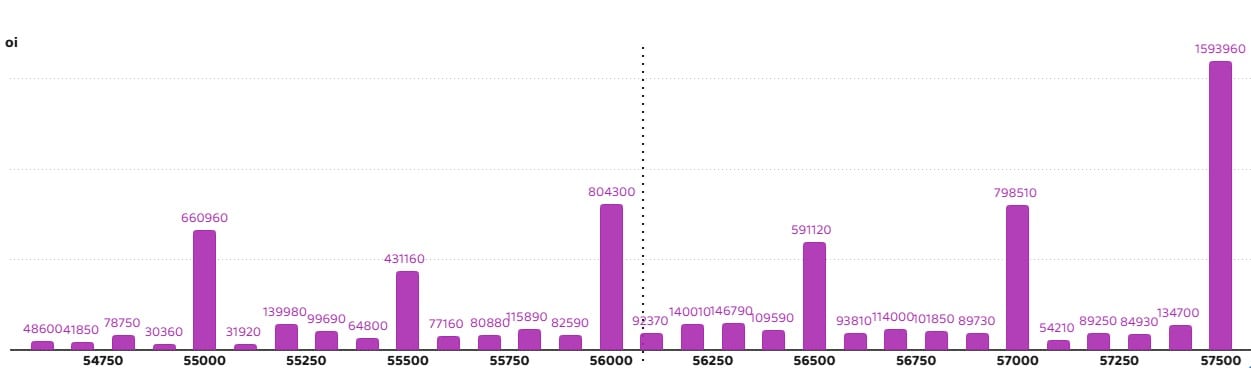
On the Put side, the 57,500 strike holds the maximum Put open interest (with 15.93 lakh contracts), which can act as a key level for the index in the short term. This was followed by the 56,000 strike (8.04 lakh contracts) and the 57,000 strike (7.98 lakh contracts).
The maximum Put writing was placed at the 55,000 strike (which added 15,180 contracts), followed by the 55,300 strike (12,510 contracts) and 55,600 strike (11,610 contracts). The maximum Put unwinding was seen at the 57,500 strike, which shed 77,790 contracts, followed by the 56,000 and 57,000 strikes which shed 63,960 and 62,790 contracts, respectively.
Report by Sunil Sankar Matkar
Source: Network18
Tuesday, September 15, 2026
15/09/26, Market expecting positive start
Indian benchmark indices Sensex and Nifty are likely to open with cautious gains on Tuesday after the long weekend, with GIFT Nifty pointing to a positive start. However, Brent crude prices above $106 a barrel, continuing Middle East tensions and caution ahead of the US Federal Reserve's policy decision temper the global backdrop. Indian markets were closed on Monday for a holiday and will be absorbing two days of global developments when trading resumes.
GIFT Nifty was trading at 23,521 around 8 am, up 77 points, or 0.33 percent, from Monday's close. It was about 66 points, or 0.28 percent, above its Friday close. Indian equities had recovered sharply from their intraday lows in the previous trading session on Friday, September 11, but still ended marginally lower. The Sensex fell 120.83 points, or 0.16 percent, to 74,781.76, while the Nifty declined 79.70 points, or 0.34 percent, to 23,398.10, amid selling in metal, realty and PSU bank stocks.Asian markets cautious ahead of US Fed decision
Asian markets were struggling for direction ahead of central bank decisions in the US and Japan. The stocks were subdued on Tuesday as investors weighed geopolitical risks, high crude oil prices and concerns around the artificial-intelligence trade.MSCI's broadest index of Asia-Pacific shares outside Japan slipped 0.12 percent, with South Korea's Kospi down 0.25 percent. Japan's Nikkei reversed early losses to trade 0.19 percent higher, while Hong Kong's Hang Seng fell 0.4 percent and the Shanghai Composite declined 0.3 percent.Brent above $106 as Middle East supply risks persist
Crude oil remains a major concern for Indian markets, with prices rising again on Tuesday amid fresh threats to Middle Eastern energy infrastructure. Brent crude climbed 1.21 percent to $106.96 a barrel, while West Texas Intermediate rose 1.27 percent to $102.68. Yemen's Iran-aligned Houthis launched another attack on Saudi Arabia on Monday, while Riyadh blamed Iran-backed fighters in Iraq for an attack on the kingdom's east-west pipeline that it said could disrupt as much as 4 percent of global oil supply. Gulf Arab states also postponed planned talks with Iran.Ponmudi R, CEO of Enrich Money, said the macroeconomic pressure from higher oil prices amid an uncertain geopolitical backdrop is likely to keep investor sentiment guarded at higher levels.Wall Street falls; US 10-year yield briefly crosses 5%
US equities ended lower on Monday, and US Treasury yields remained elevated. Technology stocks were under pressure as investors also prepared for this week's Federal Reserve decision. The S&P 500 declined 0.48 percent to 7,619.94, while the Nasdaq fell 0.56 percent to 26,186.41 and the Dow Jones Industrial Average slipped 0.29 percent to 52,421.17.Nvidia and other chipmakers came under pressure after senior executives at US artificial-intelligence companies raised safety concerns and called for a slowdown in AI development.15/09/26, Bloomberg Report on BitCoin
A rally in crypto markets has stalled as optimism wanes that a key US regulatory bill will progress this week.
The odds of the Clarity Act passing this year, which had jumped above 30% on Polymarket during the US trading session, fell back to 18% early Tuesday in Asia. That saw Bitcoin — which accounts for around 60% of the market value of all cryptocurrencies — retreat from as high as $79,586 to below $78,000 as of 8:40 a.m. in Singapore.15/09/26, National Stock Exchange I P O
Brokerages are positive on the upcoming public issue for the National Stock Exchange (NSE), as a result of its strong market position, profitability, and the overall long-term growth potential of India's capital markets.
SAMCO Securities has recommended subscribing to the NSE's issue for the long term, saying that the exchange is one of the strongest market infrastructure businesses in India. In FY26, the exchange had a 92.99 percent market share in cash equities, 99.79 percent in equity futures and 74.71 percent in equity options.Disclaimer: The views and investment tips expressed by investment experts here are their own and not those of us. We advises readers and traders to check with certified experts before taking any investment decisions.
Today's
21/09/26, Shaleen Agrawal's Report on Market
Indian benchmark indices Sensex and Nifty are likely to open largely flat-to-negative on Monday, with GIFT Nifty pointing to a muted start...
-
Bears are showing no signs of relinquishing control, dragging the Nifty 50 down 1.2 percent despite a gap-up opening on September 15. Techni...